Lloyd’s has recently added weight to this view in an update from Patrick Tiernan (Chief of Markets). When talking about the longer term nature of DA agreements and their performance lag he explained “in softening conditions, performance has tended to deteriorate more quickly, and, likewise, as the market hardens, remediation efforts take longer to take effect”. He went on to reference the need for appropriate governance, alignment of interests and transparency.

Underneath the skin, this message from Lloyd’s is focused on profitability and market cycles. That is noteworthy as companies’ oversight of DA arrangements has focussed more on technical and contractual compliance.

So if we acknowledge this changing view, how do DA businesses and their capacity providers move to a process that ensures profitability over those market cycles?


In short this requires portfolio management that is governed and transparent.

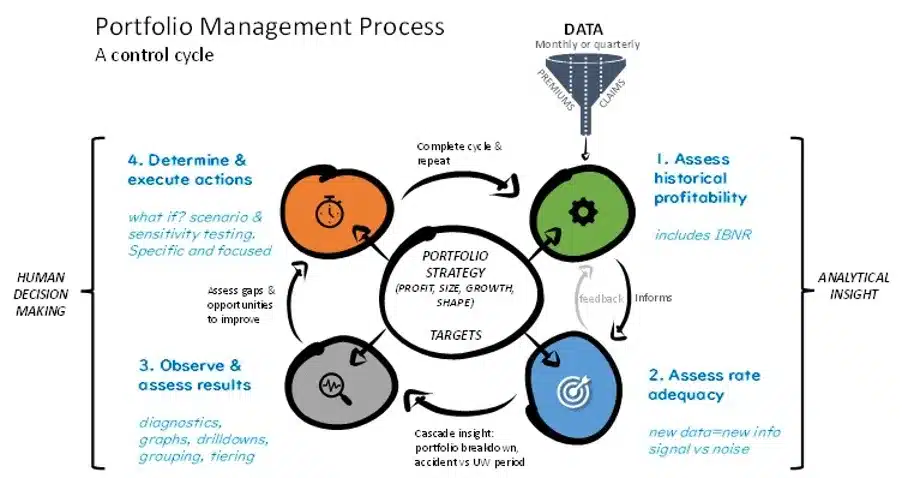
Portfolio management in this context, as illustrated below, is the constant cycle of assessing performance and profitability to determine actions to improve.

The key to governing such a process is the constant cycle and ongoing monitoring. It is important for MGAs and capacity providers to establish the right leading indicators at the right granularity. They may be unsurprising (e.g. loss ratio) but must be constantly watched. In turn when actions are taken as a result of these indicators, it is important to monitor their effectiveness to feed back into the cycle.

Trends are spotted quickly through the leading indicators – be they price adequacy, claims inflation, underwriting cycle or changes in underwriting standards.  Tiernan’s observation that hardening phases of the cycle tend to be slow in the DA sector is particularly interesting – it speaks to picking up these early indicators both in soft and hard markets and responding to optimise performance at all times.

At Calibrant our mission is successful portfolio management with robust processes.  We are pleased to see the market mood is aligning to that way of thinking.  We think portfolio management is a good thing in its own right, but when the regulators say it we modestly sit back and let the more influential voices speak for us.

Other articles...

To err is human, to underwrite divine

There has been a lot of speculation recently around the use of AI in insurance and how this signals the death knell for Underwriters. Having mopped up the coffee that I spat out and checked my life insurance provisions, this got me to thinking. Surely not all underwriters? But if not, then who?

READ MORE
Efficient or effective?

The ineffable question of the “effs”.  What should a business aim for – and more specifically, for us, the underwriting function in an insurance business – efficient operations or effective decision making?

READ MORE
The boiling frog

We have all heard of the boiling frog syndrome which says: if a frog is put in boiling water, it will jump out to protect itself. However, if you place a frog in cold water and slowly turn up the heat, it won’t notice the subtle increase in temperature and be boiled alive.

READ MORE
Playing the game

Game theory aims to shed light on outcomes where multiple actors operate.  Dry academe often assumes “ceteris paribus” even in social sciences, but in the real world when we are trying to anticipate the outcomes of decisions one actor makes it is essential to consider the possible and likely responses of other actors…

READ MORE
Stick to Your Knitting

Managing General Agents (MGAs) provide insurers a broad opportunity for profitable growth. Operating in niche sectors with lean efficient models and providing customers with products that they often find hard to come by in the mainstream.  All of this is wrapped up with the relevant expertise and providing insurers with access to markets that…

READ MORE
Why an MGA shouldn’t fear the hard market

As 2022 was drawing to a close, insurers across the UK were starting to look at their results, keeping their fingers, toes and everything else that they could, crossed in the hope that December would fizzle out in a whimper.

But alas it was not to be as temperatures plummeted and the industry suffered…

READ MORE
Actuarial big bucks

What use statisticians and actuaries when the world is being transformed by modern data-analysis techniques?  What hope for clunking humans in the era of Big Data (Facebook sells data which influences US presidential elections), of Artificial Intelligence (China can identify disliked racial groups through automatic facial recognition technology)…

READ MORE
Pricing triptych – Part 3: Four fallacies about cat pricing

Catastrophes – natural events where one “system” (wind, earthquake etc) causes multiple insurance claims in one go – are difficult.  Much else in insurance pricing is subject to conceptually simple averaging-over-time, but cats are different.  You can’t take a 5 or 10 year history of natural-peril losses and assume you have an accurate view of exposure to catastrophes…

READ MORE
Pricing triptych – Part 2: Four considerations on pricing strategy

In part 1 of this triptych on insurance pricing we looked at Technical Price (TP): what must be covered over the long run to make reasonable profits.  I finished that note by considering TP in the context of the market.  Here, I take this theme further and explore more how to think strategically about pricing.

READ MORE
Pricing triptych – Part 1: The four fundamentals of pricing

This note covers the fundamentals: the three building blocks of a technical price and a note on the role technical price plays.  It is followed with a deeper look at pricing strategies.  Finally we consider a knotty topic, cat(astrophe) pricing, in particular the use of cat models to inform the price.

READ MORE
In data we trust (so make sure it’s right)

On 26th September 1983, at the height of the Cold War, Soviet missile monitoring picked up apparent signs of five nuclear missiles launched from the US.  Retaliation was the default planned reaction.

READ MORE
Conflict: anticipating it, managing it

Charles Dickens opened A Tale of Two Cities with these lines, contrasting calm enlightenment London with turbulent revolutionary Paris: “It was the best of times, it was the worst of times…

READ MORE
Carrier vs MGA

Calibrant was established to bridge a gap.  The gap is that between MGAs and their carriers.  And it finds many forms.

READ MORE