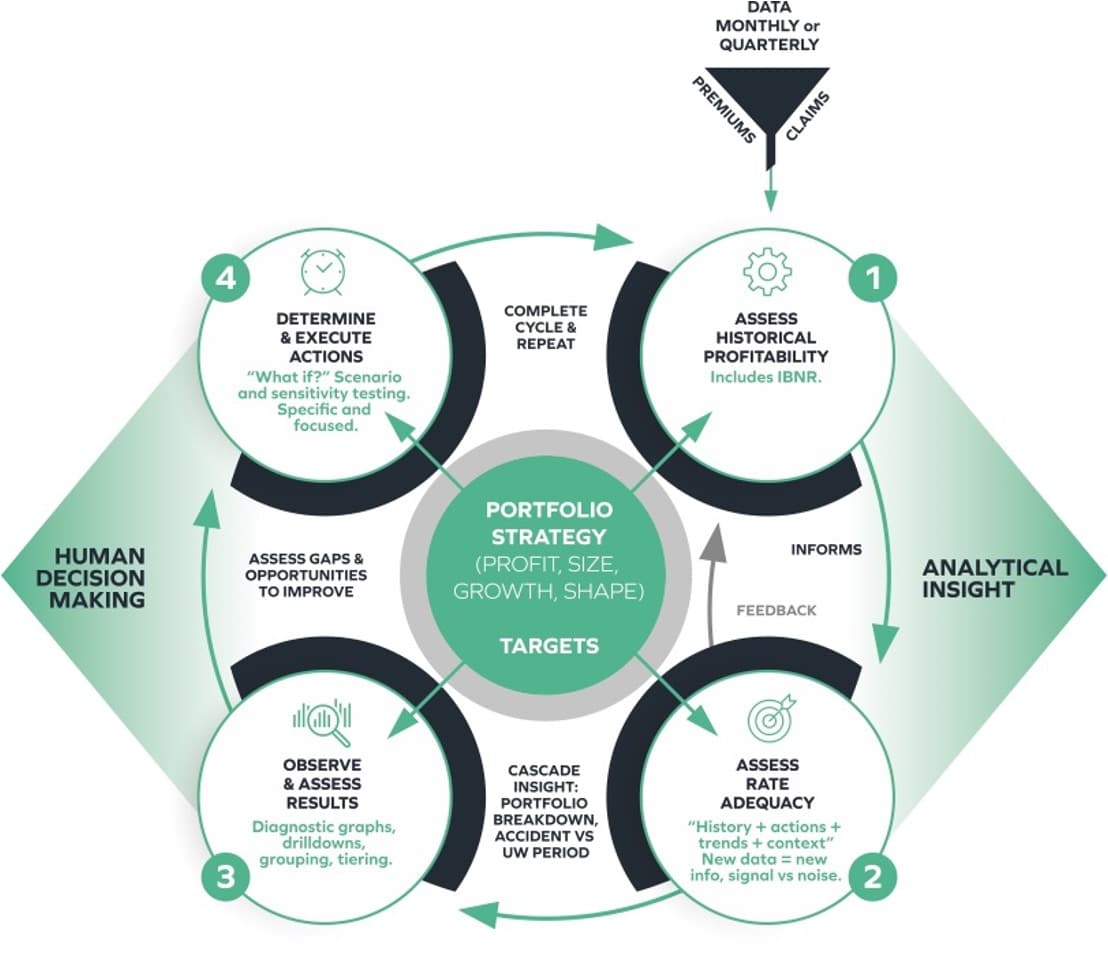
The Four Stages of the Steering Loop

Stage 1 – Understand where you’ve been

Assess the historical performance of the portfolio at a granular, component level. Evaluate how the rating and underwriting mix changes applied in the past have impacted performance. Review and validate modelling assumptions, including robust IBNR provisions. These are the foundations on which we lay the credibility of our forward-looking outlook.

Stage 2 – Predict your trajectory

From the insights garnered through stage 1, form an actuarially informed view of how the business being written today is expected to earn out over the current underwriting period. Effectively, understand the rate adequacy of the portfolio by component.

Stage 3 – Shape the journey

Use the results so far to decide where to grow, maintain, or improve. Define resulting actions that are measurable so you can quantify their impact on GWP, loss ratio, and overall portfolio shape.

Stage 4 – Steer the course

As results are earned through, it is fundamental to separate the signal from the noise and look for early divergence from expectations. Incorporate this with the impact of external drivers, e.g. inflation, competitor activity, and adjust quickly to keep the portfolio on track.

A good portfolio management approach will cycle through the steering loop repeatedly, enabling timely and targeted actions to be taken to meet profitability objectives.


Why Steering Beats “Set and Forget”

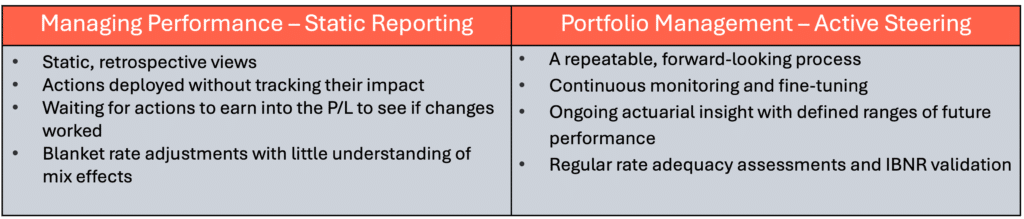
Quite often we see that profitability is assessed in the here and now – a single snapshot of what performance looks like today, usually at a high level. There is little insight into the good (and bad) performing areas of a portfolio, and frequently, we see ‘blanket’ actions followed by a year of waiting to see if they worked.

Steering, through disciplined portfolio management, unlocks valuable insight that simple snapshots miss; it provides us with the clarity to understand:

  1. Which segments of a portfolio to target
  2. The quantum; and
  3. How these changes will impact all facets of the portfolio from GWP to loss ratio

A Practical Illustration: Guarding Thin Margins

Let’s say we have a portfolio, currently running at a loss ratio of 48% against a maximum target of 50% at which point this becomes unprofitable for a carrier.

Assuming the carrier is comfortable continuing to write to a 48% loss ratio, this leaves little margin for deterioration in performance and so early identification of any slippage, and swift corrective action is critical.

Steering makes it possible to manage the loss ratio with some certainty; it enables the portfolio to be assessed at a component part and in aggregate, it links actions to expected improvements, and it monitors whether those improvements are actually earning through.

Portfolio management enables us to answer the fundamental questions needed to achieve target performance.

The Steering Questions Every MGA Should Continuously Answer:

  • What is the expected profitability of the business written this month vs. last month (and prior months), and, all else held equal, how will those cohorts earn through into the portfolio loss ratio over the next 12 months?
  • Are IBNR assumptions adequate, and how does their range of outcomes influence the ultimate loss ratio projection?
  • Are existing rating/underwriting actions earning through as expected and delivering the forecasted benefits in the emerging results?
  • Is the profile and underwriting mix shifting? If so, is this toward more, or less profitable segments of the portfolio?
  • How should external factors (e.g. claim inflation and competitor activity) be transposed onto the forward-looking view so expectations remain realistic and actionable?

What “Great” Looks Like

To steer a portfolio effectively and achieve sustainable results, great portfolio management discipline must reflect a continuous cycle of analyse, project, and adjust. Fundamentally, at its core, it should exhibit the following characteristics:

  • A repeatable process, not ad‑hoc reviews
  • Forward‑looking as well as historical—the future is modelled with ranges and scenario testing
  • Tracking of underwriting actions as they earn through versus expectation
  • Constant fine‑tuning and agitation (small, frequent adjustments)
  • Clear view of trends and direction of travel at a component level
  • Actuarial clarity with a defined range of future performance
  • Solid understanding of IBNR and claim development
  • Regular rate adequacy assessments tied to mix and appetite

Steering weaves together past, present, and future. It allows us to learn from history, set an informed forward view, act intentionally, and verify that reality is tracking the plan; adjusting fast when it isn’t. That’s what great portfolio management looks like for an MGA and why it should consistently deliver target profitability.

Other articles...

To err is human, to underwrite divine

There has been a lot of speculation recently around the use of AI in insurance and how this signals the death knell for Underwriters. Having mopped up the coffee that I spat out and checked my life insurance provisions, this got me to thinking. Surely not all underwriters? But if not, then who?

READ MORE
Efficient or effective?

The ineffable question of the “effs”.  What should a business aim for – and more specifically, for us, the underwriting function in an insurance business – efficient operations or effective decision making?

READ MORE
The boiling frog

We have all heard of the boiling frog syndrome which says: if a frog is put in boiling water, it will jump out to protect itself. However, if you place a frog in cold water and slowly turn up the heat, it won’t notice the subtle increase in temperature and be boiled alive.

READ MORE
Playing the game

Game theory aims to shed light on outcomes where multiple actors operate.  Dry academe often assumes “ceteris paribus” even in social sciences, but in the real world when we are trying to anticipate the outcomes of decisions one actor makes it is essential to consider the possible and likely responses of other actors…

READ MORE
An inspector calls

In various parts of our lives, we are examined and tested to grade our ability and knowledge, be that driving tests, ‘A’ levels, or piano exams.

And so it is with the insurance industry.  Boards and regulators are increasingly pushing for demonstrable oversight.  This is especially true in the field of Delegated Authority (DA)…

READ MORE
Stick to Your Knitting

Managing General Agents (MGAs) provide insurers a broad opportunity for profitable growth. Operating in niche sectors with lean efficient models and providing customers with products that they often find hard to come by in the mainstream.  All of this is wrapped up with the relevant expertise and providing insurers with access to markets that…

READ MORE
Why an MGA shouldn’t fear the hard market

As 2022 was drawing to a close, insurers across the UK were starting to look at their results, keeping their fingers, toes and everything else that they could, crossed in the hope that December would fizzle out in a whimper.

But alas it was not to be as temperatures plummeted and the industry suffered…

READ MORE
Actuarial big bucks

What use statisticians and actuaries when the world is being transformed by modern data-analysis techniques?  What hope for clunking humans in the era of Big Data (Facebook sells data which influences US presidential elections), of Artificial Intelligence (China can identify disliked racial groups through automatic facial recognition technology)…

READ MORE
Pricing triptych – Part 3: Four fallacies about cat pricing

Catastrophes – natural events where one “system” (wind, earthquake etc) causes multiple insurance claims in one go – are difficult.  Much else in insurance pricing is subject to conceptually simple averaging-over-time, but cats are different.  You can’t take a 5 or 10 year history of natural-peril losses and assume you have an accurate view of exposure to catastrophes…

READ MORE
Pricing triptych – Part 2: Four considerations on pricing strategy

In part 1 of this triptych on insurance pricing we looked at Technical Price (TP): what must be covered over the long run to make reasonable profits.  I finished that note by considering TP in the context of the market.  Here, I take this theme further and explore more how to think strategically about pricing.

READ MORE
Pricing triptych – Part 1: The four fundamentals of pricing

This note covers the fundamentals: the three building blocks of a technical price and a note on the role technical price plays.  It is followed with a deeper look at pricing strategies.  Finally we consider a knotty topic, cat(astrophe) pricing, in particular the use of cat models to inform the price.

READ MORE
In data we trust (so make sure it’s right)

On 26th September 1983, at the height of the Cold War, Soviet missile monitoring picked up apparent signs of five nuclear missiles launched from the US.  Retaliation was the default planned reaction.

READ MORE
Conflict: anticipating it, managing it

Charles Dickens opened A Tale of Two Cities with these lines, contrasting calm enlightenment London with turbulent revolutionary Paris: “It was the best of times, it was the worst of times…

READ MORE
Carrier vs MGA

Calibrant was established to bridge a gap.  The gap is that between MGAs and their carriers.  And it finds many forms.

READ MORE